MatForge
Four SIGGRAPH papers in one Vulkan path tracer
Vulkan 1.3, Slang, C++ · Nov – Dec 2025 · Team of 3
- +2.57 dB PSNR over PCG sampling at 512 spp
- 44.7% lower MSE than PCG
- <1% sampling overhead

A GPU path tracer that implements four SIGGRAPH and SIGGRAPH Asia papers (2023–24) in one Vulkan ray tracing pipeline, built by three of us in five weeks for CIS 5650, on NVIDIA's nvpro vk_gltf_renderer. I wrote 2,400+ lines of its C++ and Slang: the sampling, its convergence analysis, and the RMIP intersection shader.
One pipeline, four papers
Each paper owns a stage of a path's life:
- Sampling. Quad-optimized low-discrepancy sequences supply the random numbers.
- Geometry. RMIP ray-traces displacement maps directly, with no tessellation.
- Directions. Bounded VNDF sampling picks GGX reflection directions.
- Evaluation. Fast-MSX adds back the energy rough microfacets lose to multiple scattering.
- Integration. Monte Carlo combines them:
f(ωi, ωo) · L(ωo) · cos θ / pdf.
Quad-optimized sampling
From Ostromoukhov et al., SIGGRAPH 2024: low-discrepancy sequences optimized for the 2×2 pixel quads a GPU shades together, filling the sample space better than standard Sobol'. I built it end to end. On the host, a builder constructs the generator matrices of a base-3 Sobol' sequence from irreducible polynomials; on the GPU, a Slang sampler draws Owen-scrambled points, tracking each path's dimension, across 47 dimensions and up to 243 (3⁵) points. A toggle switches between it and PCG while rendering.
| Samples per pixel | QOLDS | PCG | Gain | Lower MSE |
|---|---|---|---|---|
| 64 | 37.70 dB | 37.24 dB | +0.46 dB | 10.1% |
| 128 | 40.67 dB | 39.80 dB | +0.87 dB | 18.2% |
| 256 | 43.58 dB | 42.03 dB | +1.55 dB | 30.0% |
| 512 | 46.38 dB | 43.81 dB | +2.57 dB | 44.7% |
To measure it I wrote an automated convergence framework: it renders each sampling configuration, scores the images by PSNR, MSE and SSIM, and writes the results as CSV for plotting.
Displacement without tessellation
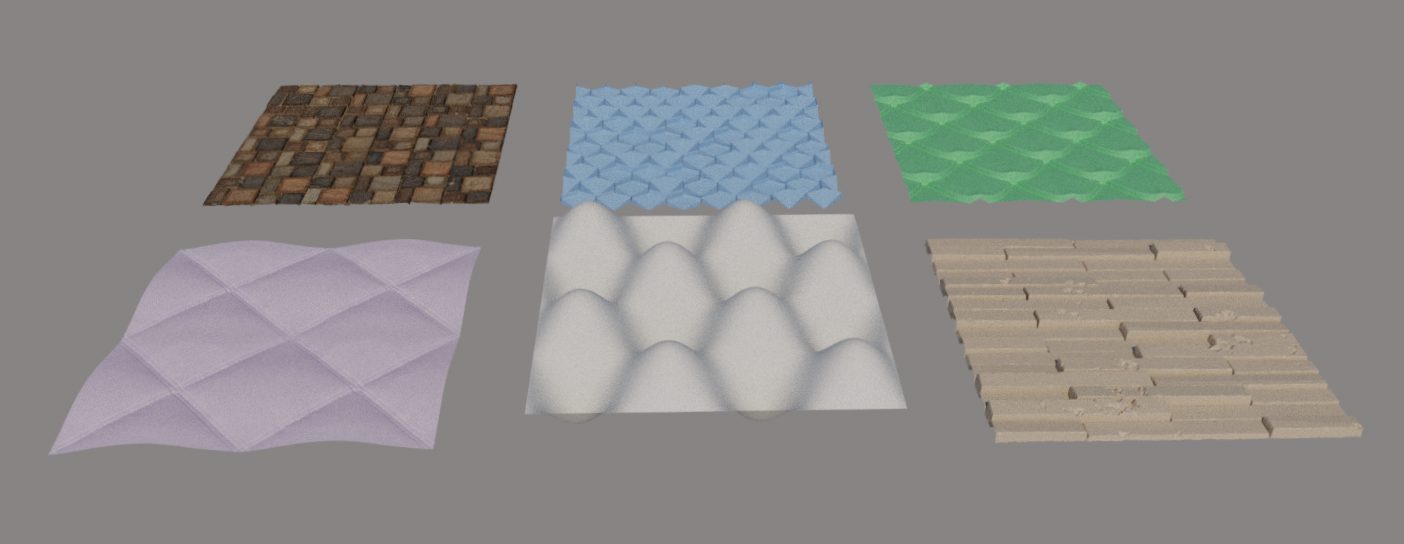
RMIP, from Thonat, Georgiev, Beaune and Boubekeur (Adobe, SIGGRAPH Asia 2023), ray-traces displacement maps directly instead of tessellating them into triangles. A rectangular min-max image pyramid bounds the displaced height over any rectangle of texels, so a ray can be traversed through texture space hierarchically, skipping whole regions it can't hit. Cecilia built the pyramid and analyzed it; I wrote the custom Vulkan intersection shader that traverses it and reports where a ray meets the displaced surface, with support for glTF's KHR_materials_displacement. Getting it visually correct took 24 rounds of fixes.
| Samples per pixel | PSNR, all leaves / ψ | SSIM, all leaves / ψ | ψ speedup |
|---|---|---|---|
| 4 | 26.15 / 26.17 | 0.6396 / 0.6412 | 3.19× |
| 16 | 32.22 / 32.27 | 0.8772 / 0.8789 | 1.42× |
| 64 | 38.42 / 38.65 | 0.9675 / 0.9692 | 1.15× |
| 256 | 45.38 / 47.28 | 0.9933 / 0.9950 | 0.93× |
| 512 | 50.26 / 49.95 | 0.9978 / 0.9976 | 0.77× |
The material model
Xiaonan built the other two papers into the material system:
- Bounded VNDF sampling (Eto and Tokuyoshi, AMD, SIGGRAPH Asia 2023) samples GGX reflections from a tighter spherical cap,
k = (1 − a²)s² / (s² + a²z²), wasting fewer samples. In our tests it matched standard VNDF from α = 0.3 up and trailed it at low roughness, by 6.5 dB at α = 0.1, so standard VNDF stayed the default. - Fast-MSX (SIGGRAPH 2023) adds the energy a single-scattering GGX BRDF loses at high roughness, through a relaxed V-cavity model. At α = 1.0 it reached about 48 dB at 512 spp, where plain GGX leveled off near 31.
The demo scene
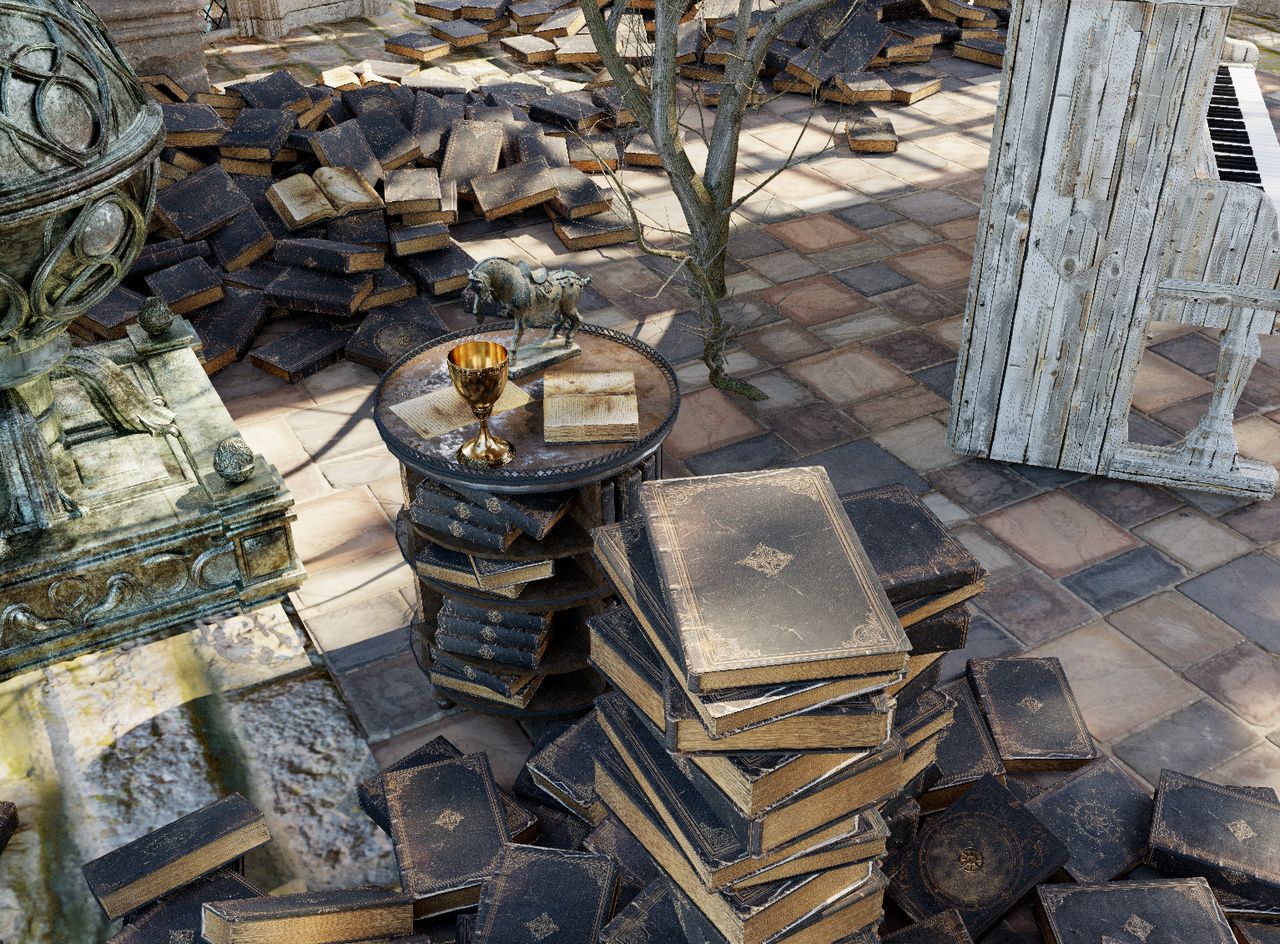
Sweeper3D's Forgotten Hall, with many of its materials and textures reworked so each paper has something to show: displaced stone paths, terrain and roof tiles for RMIP; rough stone, aged wood and metal fittings for the microfacet models; and foliage-dappled indirect light for the sampling.